How Do Stop Signs Work? Rules, Right of Way, and Common Mistakes
Many experienced drivers take stop signs for granted, but new drivers can find the rules surrounding this red octagon challenging. Failing to come to a complete stop can result in a moving violation that affects your car insurance rates. Use the guide below to learn how stop signs work and what you should do the next time you encounter one.
The Birth of the Stop Sign
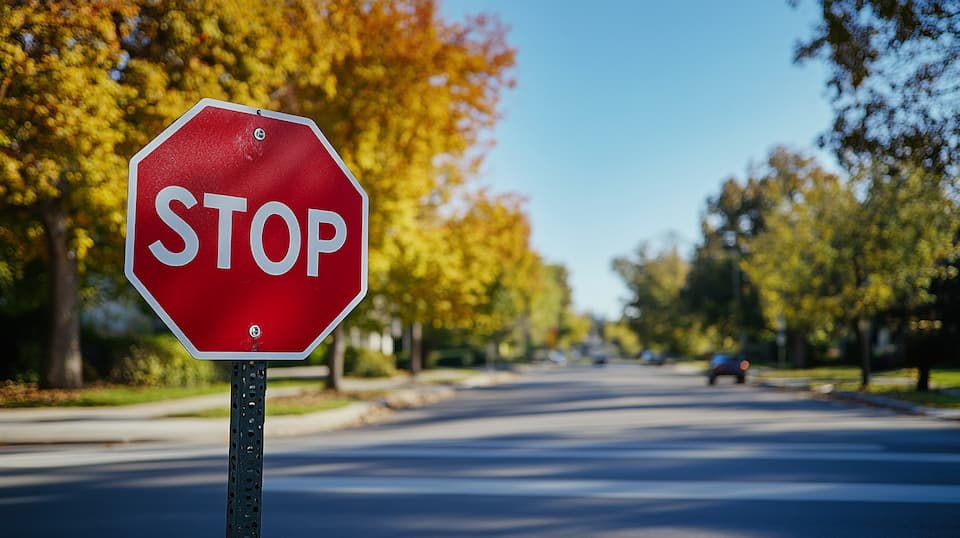
A stop sign is a red, octagonal traffic sign that requires drivers to come to a complete stop before proceeding through an intersection. Today it is one of the most recognizable road signs in the country, but there was a time when stop signs did not exist at all.
The first stop sign was installed in 1915 in Detroit, Michigan. William Eno is widely recognized as its inventor. Interestingly, the first stop signs were not actually red. Instead, they were painted yellow so they could be seen more easily in the dark, similar to the modern yield sign. In fact, most stop signs and other regulatory signs were yellow from the 1920s to the 1950s, according to AAA. It was not until 1954 that the Manual on Uniform Traffic Control Devices required stop signs to be the red-and-white shapes you see today.
According to the New York State Local Technical Assistance Program Center, hosted by the Cornell Local Roads Program, modern stop signs must be located on the right side of the road at least six feet from the pavement edge. The stop sign must also be no more than 50 feet from the intersection. If no stop line exists, the sign must be placed so that you can clearly see traffic in both directions before proceeding.
What to Do at a Stop Sign
You must bring your vehicle to a complete stop every time you encounter a stop sign. While that sounds straightforward, the stopping procedure involves a few specific steps:
- Come to a complete stop so your vehicle remains fixed in one spot for a few seconds.
- Stop behind the white stop line painted on the road, if one is present.
- Proceed only when conditions are safe to do so.
If you encounter a school bus with a deployed stop sign, you must stop in front of it. Allow any pedestrians to cross and wait until the bus driver stows the stop sign before proceeding with caution. Failing to yield and stop in this situation can put several lives in danger and result in significant penalties. Stop sign rules also include recognizing who has the right of way and the order of priority in various situations.
Who Has the Right of Way at a Stop Sign?
Right of way is the order in which vehicles proceed when interacting at intersections and other traffic scenarios. It applies beyond stop signs as well. For example, vehicles moving through an intersection with a green traffic light have the right of way, which means you must wait until the lane is clear before turning left. A driver turning right at an intersection also has the right of way over vehicles turning left.
Consider a scenario with a continuous road running east and west, with stop signs halting northbound and southbound traffic near the middle of the road, creating a four-way intersection. Unless you are heading east or west on the main road, you must stop and yield to oncoming traffic. The first vehicle to arrive at the intersection on the northbound or southbound route has the right of way since it arrived first.
At a four-way stop, traffic in all directions must come to a complete stop and proceed only when conditions are safe. Priority goes to the vehicle that arrives first and continues in order of arrival. If two vehicles stop at roughly the same time, the vehicle on the right has the right of way.
Pedestrians and bicyclists must also follow right-of-way rules on public roads. Pedestrians have the right of way under the walk signal, but bicyclists must yield the right of way just as if they were vehicles. A bicyclist who does not stop at a stop sign can receive a moving violation for failure to stop.
Common Stop Sign Mistakes
New drivers often make a few mistakes when approaching stop signs, including stopping beyond the stop line and committing a rolling stop. In some cases, drivers fail to see a stop sign entirely. Review these common stop sign mistakes and keep them in mind the next time you get behind the wheel.
Stopping Beyond the Stop Line
Many drivers bring their vehicle to a stop past the white stop line, pulling up directly next to the stop sign. You might do this to get a better view of cross traffic, but you must first stop at the stop line and then creep forward with caution once you confirm the road is clear. Otherwise, you may be cited for failing to stop completely.
Rolling Stop
A rolling stop happens when you tap the brakes to slow down and then continue forward without fully stopping. While it may seem safe in certain situations, you can still receive a citation if caught. The few extra seconds it takes to stop completely behind the line could alert you to conditions you were not previously aware of and help you avoid an accident.
Failing to Stop Entirely
In the most serious cases, a driver can miss a stop sign, whether from distraction or impairment, and drive through an intersection without touching the brakes. Failing to stop at a stop sign can also result in failing your driving test. Regardless of the reason, running a stop sign puts you and everyone around you at serious risk.
Frequently Asked Questions
What happens if you run a stop sign?
Running a stop sign is a moving violation that can result in a fine, points on your driving record, and increased insurance rates. More importantly, it significantly raises your risk of a collision at the intersection.
Who goes first at a four-way stop?
The vehicle that arrives first goes first. If two vehicles arrive at the same time, the vehicle on the right has the right of way. All drivers must come to a complete stop before proceeding.
Can you get a ticket for a rolling stop?
Yes. A rolling stop, where you slow down but do not fully stop, is treated the same as running a stop sign in most states. You must bring your vehicle to a complete stop at every stop sign.
Stay Safe on the Road
Understanding how stop signs work is a key part of safe driving. By stopping completely, following right-of-way rules, and staying alert at every intersection, you help protect yourself and everyone around you. If your vehicle has been involved in a collision at an intersection, Crash Champions can help restore it to pre-accident condition. Find your nearest location to schedule a free estimate.
The information in this article is provided for educational purposes and may not reflect every situation. While we strive for accuracy, this content is general guidance, not a substitute for visiting your local collision repair provider. For questions about your specific vehicle or repair needs, contact your local Crash Champions team.